Wednesday, May 28, 2014

The Tree of Life

Malheur NWR is an amazing 187,000 acres of marsh lands and sage brush steppe. The Malheur Headquarters has a combination of large Cottonwoods, Slippery Elm and various ornamental trees that act like a magnet for attracting migrating birds. For migrating songbirds the Headquarters is welcoming beacon following their nightly migration travels. (yes-most birds migrate at night) You can just imagine finishing an all-night flight looking for a place to land to rest and feed....Headquarters is the only place for miles with such lovely inviting habitat.

Each morning we load up the truck around 6:30- 7:00 to get ready for the days survey activities and we stop by and see who has arrived into the trees at HQ. We have to be very disciplined to make sure we make it out of HQ to take care of our duties- it would be easy to spend the day there enjoying all of the migrating birds on their incredible journey:)

Malheur Headquarters

Hence, Headquarters (HQ) is a spring migrant bird trap attracting birders from all over the Pacific Northwest. Within the HQ complex is a small group of flowering trees dominated by this Prairie Crabapple Tree that is the first to bloom.

Once the sun warms the tree-it fills with bees that attract the birds.


One warm day the trees were filled with bees and other insects acting as dinner bell to the hungry birds.

These Western Tanagers are some of the most colorful visitors. They love the bees:)
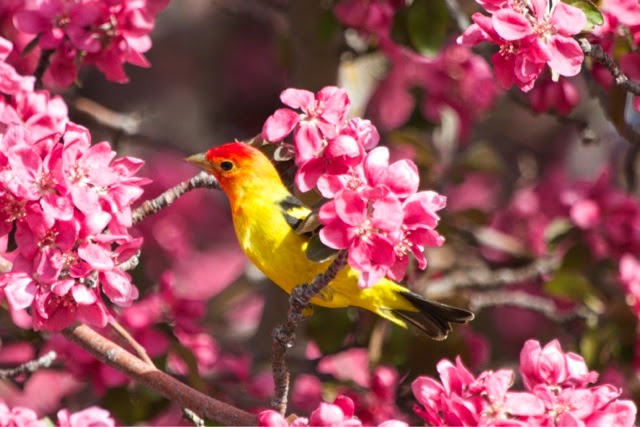
This guys is eating a bee. They actually remove the stinger and then enjoy.


The striking male Bullock's Oriole also loves the bees.


This Calliope Hummingbird is not that much bigger than some of the big bees.

This female Rufous Hummingbird is enjoying the new blooms.


Notice the bee to the lower left flying away for its life:)

We had the good fortune to have a large group of Cassin's Vireos stop by. They are identifiable with their well marked "spectacles"


Here is a Warbling Vireo. They have been here for about a month so maybe they are nesting here. Right now there seems to be a pair in every tree- how wonderful is that!

The Cedar Waxwings look like they are out of a charcoal painting

They are actually eating the petals off the trees:)


These little female and male Black-chinned Hummingbirds enjoy the protection of the trees.


It is always a pleasure to see the Evening Grosbeaks

Here is a male Black-headed Grosbeak- I love the little patch of yellow on their belly.

We had a few days where we had large numbers of Lazuli Buntings at HQ eating out of the feeders. 

This is a beautiful male Lazuli Bunting below.


This was a new bird for us! A hybrid Lazuli x Indigo Bunting! You never know what you are going to see......

The striking nomadic Lewis's Woodpeckers are always a treat to see. At one point we had as many as 15 Lewis's hanging around HQ!! You never know where you will see a Lewis's Woodpecker.


And the warblers..... I love the warblers.....

If any bird species owns HQ- it would be the Yellow Warblers. There are Yellow Warblers everywhere- singing and calling- establishing their territories and building nests- what a wonderful experience to see.

A male Yellow Warbler

Another male Yellow Warbler....

Another Yellow Warbler.... singing with all if his heart...


And there he goes.....


This female Yellow Warbler found a wonderful place to feed on the inside of this wire tree support. Here she is safe from predators for the most part.

Below is the skulky MacGillivray's Warbler with its gray head and broken eye arc.

We had pretty good group of Nashville Warblers hang around for a week or so- enjoying the tree of life

The Nashville has the soft gray head with a full eye ring.

This Orange-crowned Warbler looks a little scruffy but is enjoying the abundance of food.

This dazzling Townsend's Warbler was enjoying the early Lilac bush blooms.


The male Wilson's Warbler is usually darting about in the back of a tree or bush- I was blessed to catch him in a moment of repose.

This Yellow-rumped Warbler is the Myrtle's subspecies- they have a white throat verses the Audubon's has a yellow throat....either color...they are very dramatic in their breeding plumage.


One of my favorite sparrows- the White-throated Sparrow- was hanging out underneath the feeders taking advantage of the fallen seeds.


There is a pond next to HQ with a nesting platform. This Osprey was looking at the site but did not nest there.


We had a Red-naped Sapsucker show up. Apparently they don't get many woodpeckers since there are not that many trees.

An immature Swainson's Hawk showed up..... this had all the local birders scratching their heads....Swainson's do not hang out here. There are lots of Red-tailed Hawks but not Swainson's. Well this Swainson's started making a nest....he would sit on the branches of big trees and break off pieces with his beak or sometimes try to break off branches with his claws. One evening we watched and listened as he came in with a mature Swainson's Hawk, they circled and called out of a few minutes and then we never saw the mature bird again. We can only imagine that this immature bird was possibly inviting this mature bird to mate with him.....for some reason she moved on. He is still here working on his nest.

Carrying a big branch...

Here he is with a branch with leaves


Turtle-dove or Eurasian Collared Dove?? There was a controversy about what this bird species is. Sometimes you aren't able to put a name to every bird and that is okay- that is the fun of it.


The noisy Yellow-headed Blackbirds are some of my favorites- the noises and calls that come out of them sound life threatening sometimes:) They love the bird seed and hang out at HQ pretty much all day with the Red-winged Blackbirds.


Here they are having a debate about who owns this feeder:)


The European Starling is considered an extremely invasive bird that is displacing many cavity nesting birds around the country. They are amazingly adaptable but you can't deny they are stunning looking birds.


It has been about 3 weeks or more since many of these photos were taken. The blooming trees have changed and the birds are continually coming and going- I guess that is the magic about birding and connecting with this special place.

The world is filled with beauty & wonder,

Turtle & Hawk


Tuesday, May 27, 2014

We Dusted off our Tent and Sleeping Bags and Hit the Woods

The Idlewild Campground is just 17 miles north of Burns, about an hour away. We love to go there to immerse ourselves in the forest in contrast to the open sagebrush & marshlands of the refuge. We have been up there birding a few times and seen some great woodpeckers and other birds and heard that they have Flammulated Owls. We thought it would be fun to clean out the cobwebs from tent and go camping up there. We wanted to have our tent so we can camp in remote locations that we cannot get Shak3 into. Idlewild is one of those small National Forest campgrounds.

We had a beautiful afternoon and evening. We hike the Devine Interpretive Trail and as we were coming back into the campground we had this male Black-backed Woodpecker grace us with his presence:


These Hermit Thrushes were having an intense discussion in our campground. We think they might be a mating pair.


This Dusky Flycatcher was hanging around at our campsite. There were Duskies perching and calling all through the campground! It really helped us to learn the call of the Dusky.

The camping experience was amazing- we slept like babies on our old blowup air mattress. The magical treat was the hooting Flammulated Owl outside of our tent:)

When we returned from camping we heard there was a pair of nesting Ferruginous Hawks down the road..... and here they were with chicks!


We are so blessed to be able to experience all of the nature around us!

Turtle and Hawk

Wednesday, May 21, 2014

You just never know what you are going to see.....

We started at our day at 3:30 am with a waterfowl survey. Hundreds of ducks and geese. We even had 2 Great Horned Owls. Then we went on to our Sandhill Crane Nesting Survey where we found 7 birds. We are so blessed to be out amongst all of this wildlife......


We came upon 7 River Otters playing and the only photo that came out was this (it is pooping)

This is a new bird for us- a male Bobolink. This bird used to be one of the most plentiful birds in North America....due to our current agricultural practices they are a fraction of their once abundant population.


Not a great photo but..... this is a Trumpeter Swan with 2 chicks!! This is amazing because there are not many Trumpeter Swans left.


A White-faced Ibis wading in the water- these birds are now abundant in the area. Very successful and beautiful!

We came home and were told that there was a White-headed Woodpecker at Headquarters- we took a walk up with the little energy we had left and low and behold..... a male White-headed Woodpecker. We hope he makes it up to the forest.

We heard that a Blackburnian Warbler was also seen at Headquarters.....maybe tomorrow.....

Life is full of beauty and wonder,

Turtle & Hawk

Saturday, May 10, 2014

What a Lek of a Day!

We have been in Malheur NWR for about 10 days. We arrived on April 24th and hit the road running, doing Greater Sandhill Crane surveys- how wonderful is that?! More on the Greater Sandhill Cranes in another blog.

We have always wanted to see a Greater Sage-Grouse Lek. Greater Sage-Grouse are famous for their elaborate courtship rituals. Each spring males congregate in leks and perform a "strutting display". It is like a choreographed dance. Ideally groups of females observe these displays and select the most attractive males to mate with. The dominant male located in the center of the lek typically copulates with around 80% of the females of the lek. Males perform in leks for several hours in the early morning and evening during the spring months, typically February - April. Lek generally occur in open areas adjacent to dense sagebrush stands, and the same lekking ground may be used by grouse for decades.

Residential building and energy development have caused the Greater Sage-Grouse population to decline from 16 million 100 years ago to between 200,000 and 500,000 today. The species is in decline due to loss of habitat; the bird's range has shrunk in historical times, having been extirpated from British Columbia, Kansas, Nebraska, Oklahoma, Arizona and New Mexico.

The lek that we visited has been known to be in this location for a very long time with around 24 males participating. There was a fire through the area in 2011 so local birders are not sure what the status of the lek is due to loss of viable habitat. The Greater Sage-Grouse's diet is totally dependent on sagebrush so loss of the sagebrush due to fire means no food for the Greater Sage-Grouse population. Currently there are only 5 males participating in the lek. Whether any females have been visiting is unknown.

We took Friday off and headed up to the lek about 4:00 am. We were in place by 5:00 am. It was still dark but we could hear them foot-drumming & hooting with their inflatable esophagal air sacs! The sun started to come up and these are a few photos of the magical dance that we there to observe:)


The world is truly filled with beauty and wonder,

Turtle and Hawk

Sunday, May 4, 2014

First Year Service & Big Swainson Surprise

We entered into the Grande Ronde Valley with the Blue Mountains on the West and the Wallowas on the East on a beautiful spring day. This is beautiful country. We were here to take care of some business and enjoy the surrounding natural beauty.

Bob & I made an appointment to have Shak3 serviced at the original manufacturer, Northwoods, in La Grande, OR 6 months in advance for a mid April appointment. This was the first annual service for our new home.

As we rushed from Ashland to La Grande after completing the sale of the house, car, etc, we had  the most extraordinary experience in the Northwoods parking lot. Just feet away from our trailer parked in an industrial parking lot, were a pair of dark morphed Swainson's Hawks.These birds migrate all the way from Argentina!! They amazingly have great fidelity to their natal nesting sites and will continue to return to the same areas year after year no matter the condition of the environment. We were shocked to see these incredibly beautiful hawks mating and nesting in this sterile industrial human environment. At one point, we witnessed the mating of the male and female Swainson's.

Swainson in flight around the parking lot


Swainsons mating across the street from the parking lot where we were parked

Male Swainson's Hawk


Once our trailer was in for service we had time to explore La Grande, OR. We found an amazing multi-agency run refuge called Ladd Marsh. It includes over 6,000 acres of the largest remaining wetlands in northeast Oregon.


It looks like these Black-necked Stilts might be making a nest

Male Cinnamon Teal

Yellow-headed Blackbird
Gadwall in flight

Male and Female Redheads
What a singer the Meadowlarks are!


The Great Horned Owl has an owlet just peaking out of the nest!!


We have never heard so many American Bitterns as our walk in Ladd Marsh needless to say seeing so many of them flying! Maybe because of mating season?


Lovely:)

Who is this? 


I added a few photos that were intended to be included. Ladd Marsh is a special place!

In Joy,

B&B