Wednesday, February 5, 2014

Enjoying life on the Big Island

The island of Hawaii is referred to the Big Island. It is so big in comparison to the other islands- you could fit all of the other islands (Maui, Oahu & Kauai) in the footprint of the Big Island! We have had the best weather we ever remember-much better than when we lived here- due to the fact that the VOG from the volcano has been minimal. We have been getting out and enjoying it:) One of our favorite things to do here is to visit the endemic forest birds at elevation. Unfortunately Hawaii has the largest number of endangered and extinct birds- I think in the world. They have been predated on by man,goats, sheep, cattle as well as mosquitos and are loosing habitat at an alarming rate. They live at elevations greater than where the avian pox carrying mosquitos can live which tends to be above 3,000ft. One of the challenges due to climate change is that the mosquitos seem to be adapting to higher elevations causing the birds' habitat to shrink. We are blessed to have some amazing places to visit these rare and endangered birds here on the Big Island. The following photos include some of the endemic (only found here on the Big Island), vagrants and introduced species we have been seeing lately.

One of our very favorite places to visit is Hakalau NWR. This is a NWR located on the east slopes of Mauna Kea. This land had been heavily grazed by cattle and some of the last endemic birds that were only found there were in decline. Forest bird surveys done in the 1970s & 80s identified this area as the best remaining habitat for the endangered forest birds. This led to the establishment of Hakalau NWR in 1985 for the purpose of protecting and managing endangered forest birds and their habitat. It is the only NWR dedicated to the conservation and restoration of Hawaiian forest birds. The wonderful news is that the restoration of the habitat is working! The bird populations in Hakalau appear to be stable or possibly even increasing.

This is an Ohia Tree below that is believed to be approximately 1,600 years old!! Imagine what this tree has seen.

The Akepa is one of the most challenging of the forest birds to see. The Akepa in the photo below is a orange sherbert color- the color indicates that the bird is in 3rd year plumage. The Akepa has a tiny cross bill that they use to pry open leaf buds, small seed pods and galls in search of insects and spiders.


The same Akepa in flight

Working the Ohia tree tops

Taking a break from foraging

This is a mature Akepa with a deeper orange color


This is an Akiapola'au another extremely rare bird ~ maybe 1,500 birds left in the wild! They feed by creeping along the branches of Koa trees using their dual purpose bill to extract insects (in their larvae or adult forms) from the bark and wood. The stout lower mandible is used to peck holes like a woodpecker, while the long slender upper mandible is used to extract their prey. (see photos below)


This is the adult beetle that the Akiapola'au love- they eat them as larvae or as adult beetlesl


The Hawaii Amakihi is the brightest and one of the most plentiful forest birds. The male is a bright yellow while the female and juveniles are more of a drab gray. They females and juveniles can be confused with the elusive Hawaii Creeper.


The elusive Hawaiian Creeper can be seen hiding in the photos below. They can be very challenging to see- in addition to the similarity between the female Amakihi the Hawaiian Creeper likes to stay hidden.


The photo below is of another of one of the most plentiful forest birds- the Apapane. The bird below is a juvenile Apapane-
That evolves into this beautiful red color. They are quite the singers too.

Here is  a juvenile I'iwi- that bill allows them to take advantage the nectar in tubular flowers.

The striking adult can be seen in the photos below


Hawaiian Goose or Nene are a success story. Nearly extinct in the wild in 1951, captive-bred birds have been reintroduced since 1957 into Haleakala Crater on Maui and in its former range on Hawaii.


This plant is Kukaenene - one of the Nene's favorite berries.


Pu'u O'o Trail is another favorite trail of ours to hike and bird. The trail heads south towards Volcano Village from the Mauna Loa side of Saddle Road. It passes over the 1855 & 1881 lava flows and through several kipuka of mixed native species and older Koa trees. Kipukas are basically windows or areas that the volcanos missed so the original vegetation still exists to provide a window to what the area would look like if there had not been an eruption. The kipukas provide wonderful habitat to I'iwi, Apapane, Amakihi, Elepaio, O'mao, Io, Akiapola'au & Nene. The trail was pioneered by early cattle ranchers moving their cattle to points on the coast to be shipped to the mainland. Many of the photos of the forest birds were taken at either Hakalau NWR or Pu'u O'o Trail.

Here is one of the two Hawaiian Hawk or Io we saw on a recent visit to Pu'u O'o Trail.


The Oma'o is an accomplished songster that sings year-round, often from an exposed perch. They love the Hawaiian raspberry or Akala berry.


They can often be found in pairs.


The Palila is one of the most endangered forest birds. They estimate that there are less than 1,500 birds remaining in the wild and their habitat is disappearing quickly due destruction from sheep and goats. They are a finch billed honeycreeper that feed primarily on mamane seed pods, as well as insects, naio berries, & mamane buds, flowers & young leaves. They breed from February to September- so were were lucky to catch them singing and calling as part of their mating ritual. And that is the key to seeing these birds is to catch them during their mating season because otherwise it can be very quite and hard to see any of these endemic forest birds. The Palila live in mamane-naio forest on the slopes of Mauna Kea from 6,000'to 9,000'.

This Palila was feeding on the mamane flowers

This Palila is feeding on the mamane seed pod

Another photo of the Palila feeding on the flowers- note how his claw is clasping a mamane bud

The bird below appears to be eating the buds or leaves of the mamane


The remaining birds are either seasonal visitors, vagrants or possibly introduces species. We were lucky enough to see the Bristle-thighed Curlew that migrates from Alaska. This bird has very good taste- we found it hanging out on a very exclusive private residential community beach. It has been reported to be found there since early December. Thank goodness for eBird.


Honokohau Harbor is part of a National Park on the Kona Coast and a great place to bird.

We saw this Gray Francolin hanging around the entrance

This Green Sea Turtles was enjoying the sun

The male House Finch has quite the orange hue in the islands.

We were so surprised to see this vagrant gull- a Laughing Gull -very far from its normal range on the east coast of North America. This is the first Laughing Gull we have seen. (winter plumage of course)


A Northern Mockingbird hangs out in this area of the coast

The Wandering Tattler spend the winter here in the islands.


The Yellow-billed Cardinal is native to South America and can be seen in abundance along the coast.

We have had one rainy stormy day that ended with this incredible rainbow and sunset below:)


We will be heading to the mainland soon & Arizona will be the location of our next volunteer opportunity for the month of March. Mahalo to the islands,

Turtle & Hawk

Sunday, January 19, 2014

What the heck is involved in counting the albatross nests on Midway?(part 2 of 2)


It has taken much work and funding to bring back the birds. With the introduction of man to the island came critters such as rats and rabbits. All birds, even seabirds, since they nest on the islands, are extremely vulnerable to the introduction of invasive animal and plant species. So it was huge when rats were removed from Midway in 1997!! 


The count process. We count albatross nests 8 am ~4 pm everyday with the exception of Christmas and New Year's Day. We were able to take a morning and extra day off this year! Everyone takes advantage of the time off to swim and explore the island. (more later)

We break into 3 teams with 6 people. Each team has 1-2 team leaders. Everyone is issued a bike upon arrival and is the main mode of transportation. 


Our fearless Team Leaders: Jill, Richard, Jenny, Martha & Breck


Each team had to come up with a name. Our team was "Noddy & Nice" - Shirley, Richard, Bob, Bettina, Jenny & David


Noddy & Nice on Eastern Island taking a break
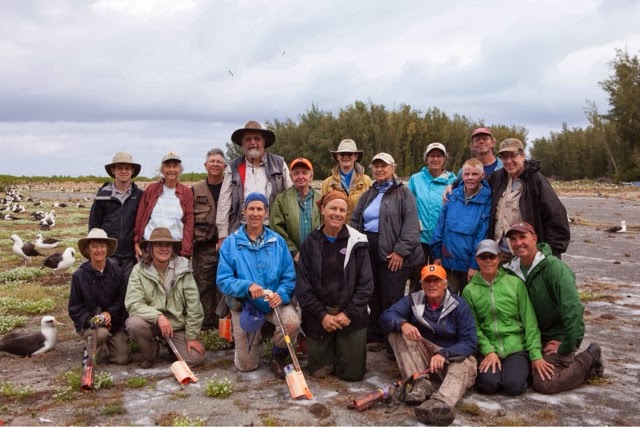
Here is the whole gang!! What a great group of folks:)

About half way through the count a special team referred to as the "Burrow Team" is formed by the lightest folks with the most experience at avoiding falling into burrows and skilled at repairing the burrows if they do happen to fall into one.

The photo below gives you and idea of the density of burrows. Each little depression in between the albatross nests is a burrow. Some are shallow and some can be very deep. When Bob would step in a deep one he would be up to his thigh!! You must think light:)


Below are photos of Bonin Petrels hanging out and digging their burrow. What a huge success story the comeback of the petrels and shearwaters is. Since the eradication of the rats the birds have slowly been coming back to the island to nest. Now the Bonin Petrel numbers are in the hundreds of thousands. When they start coming back to their burrows/nests at dusk the sky is literally filled with petrels! What a lovely sight!
Busy digging a burrow!


A pair of Bonin Petrels at night (shot lit by Aussie Bob and his flashlite)
The Burrow Team!

One of the bonuses of counting near the beach besides being near the beach is that you sometimes find glass balls. I found my first glass ball and it was a biggie!

David found his on Eastern Island.

The islands are divided into sectors with the exception of Spit Island. Spit Island is is so small it makes up only one sector.

Below is boat used to take the teams to Eastern & Spit. We usually have to make 2 trips.
The view of the beach on Eastern Island- Paradise!

The islands are pretty much naturally open and flat with the exception of some of the areas that the military builtup for armament or fortification. Ironwood trees were planted originally for wind breaks and have spread across much of the sandy coastal area. There is also napaka along the sandy beaches- some areas are thicker than others with a fair bit of heliotrope as well. The sandy open areas are filled with Bonin Petrel & Wedge-tailed Shearwater burrow holes. Most of the island beaches are closed due to being protected for  monk seals and green sea turtle habitat. 


Our counting tools consisted of a paint gun, fluorescent orange paint to mark the nests and 2 counters to keep track of Laysan & Black-footed nests.


In the morning we all meet at the "paint shed" and each team gets their assignment for the day. We then ride our bikes to the designated sector. We begin by form a line and move across the sector very slowly marking each albatross nest with a dot of paint and making a click on the appropriate counter (Laysan or Black-footed) 


We finished the count a day and a half early so we had an opportunity to volunteer for other activities for Fish & Wildlife. We did some bunchgrass planting in a newly cleared area. The area had previously had marine barracks located there. They were removed last year due to hazardous materials. The bunch grass will serve to minimize erosion and provide habitat for the birds. Here is our team.


This is where we slept- Charlie Barracks. As you can see we are surrounding by albatross nests. It is so fun to go to sleep and wake up to the sound of the birds.


This is where we ate- the Clipper House. Thai cooks prepare three meals a day for all of the staff and volunteers on island. The food is amazing- especially Christmas and New Year's Day Feasts.

A beautiful sunrise with the Midway House on the right. The Midway House is where the military commander and his family lived in the Navy days. Currently the Refuge Manager lives there. It is a beautiful house.

Cool fact-Jenny Johnson (one of our Leaders) spent a few memorable years living on Midway as a child. Her father was Harbor Master. Now she and her husband run the count here on Midway:-)


When we aren't counting albatross nests there is so much to do:

We had an informal Christmas Bird Count on Christmas Day. The photos below are a few of the birds we saw.


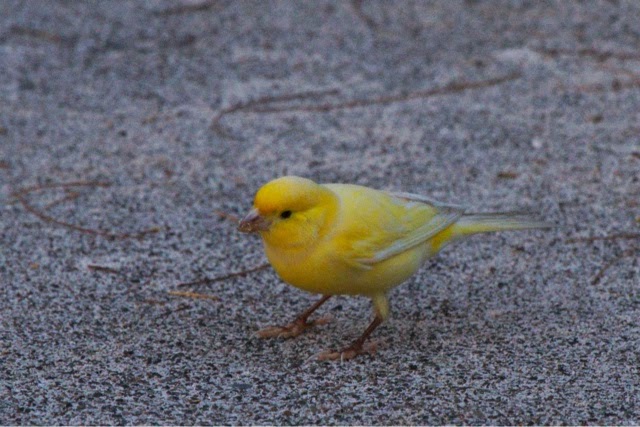
Canaries thrive here.

Sanderlings feeding on the beach.
Northern Pintails swimming around in a seep.


Wandering Tattler
Bristle-thighed Curlews could be seen perching on branches and tree stumps calling.

Pacific Golden Plover were seen all around the island.
A Peregrine Falcon we saw on last year's Christmas Bird Count.


What a wonderful place to make new friends


When the temperature was warm enough we loved to swim on this beautiful beach. The sand was like powdered sugar and the water was so soft. We would play in the waves with the albatross and boobies flying over our heads.


We love to catch the sunrise


Given the chance we were off exploring and taking photos.

Great Frigate Birds (juvenile below)

Male Adult Great Frigate Bird


Green Sea Turtle

Black Noddy on the nest in an Ironwood Tree

Adult Brown Booby

Brown Noddy in the Napaka

Short-tailed Albatross on Sand Island

Look how much bigger the Short-tailed is than the Black-footed Albatross
White-tailed Tropicbird

Black-footed Albatross doing the courtship dance

Black-footed Albatross- what a beautiful being


We saw this young Monk Seal right off the pier on Eastern Island last year


Turtlebeach- look at those huge turtles! 

Brown Booby on Eastern Island


Green Sea Turtle at Finger Piers

Hybrid Laysan-Black-footed Albatross in the foreground ( a beautiful silver breast)

Laysan Albatross at much deserved rest


Laysan Albatross coming in for a landing

Leaving on a jet plane back to Honolulu


With much appreciation of this very special place,

Turtle and Hawk